
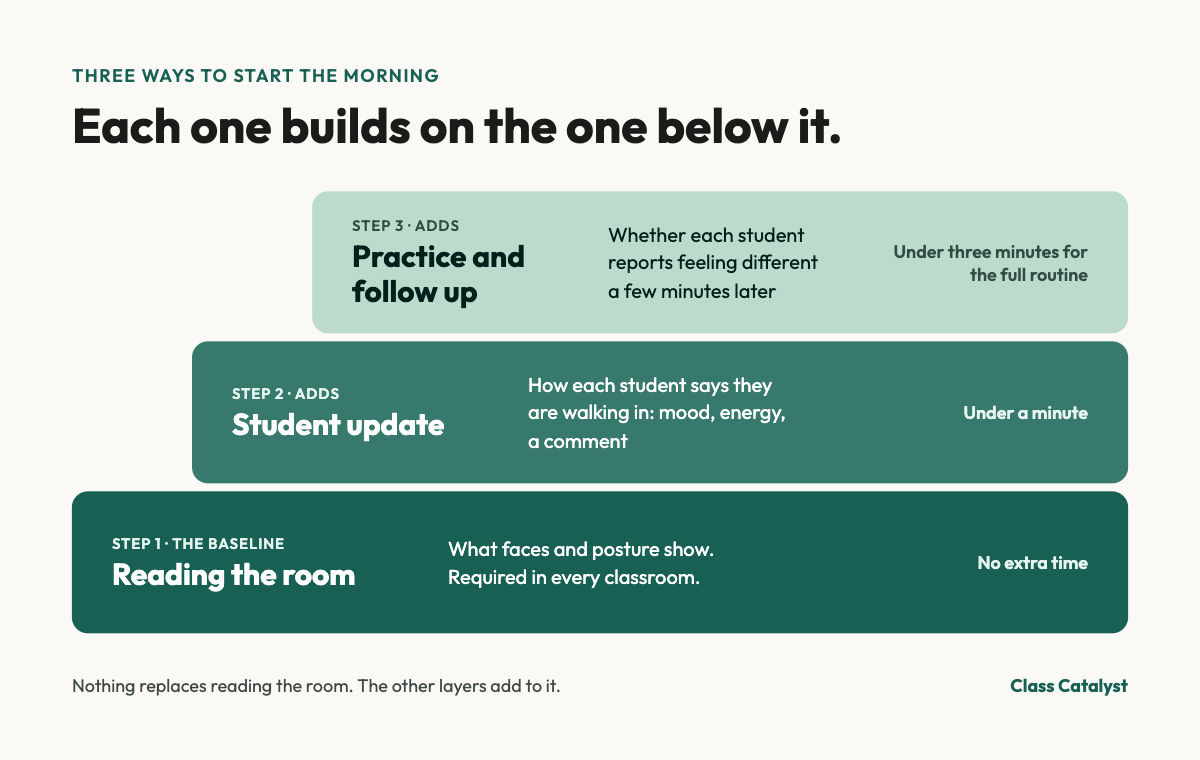
Every class starts with some read on how students are walking in. The question is how much of that read is guesswork. Here are three common approaches, what a teacher knows by the time the lesson starts under each one, and what each costs.
| Step 1 · The baselineReading the room | Step 2Reading the room + student update | Step 3Reading the room + full routine: update, practice, follow up | |
|---|---|---|---|
| What students do | Nothing extra | Share their mood and energy, with an optional comment | Share an update, do a short practice matched to it, then share again |
| Time at the start of class | None | Under a minute | Under three minutes once students know the flow |
| What the teacher knows | What faces and posture show | Everything the room shows, plus how each student says they are walking in | Everything the update shows, plus whether each student reports feeling different a few minutes later |
| What the teacher gets | A first read on every student, and the relationships to act on it. Required in every classroom | Also adds a short list of who to reach before the lesson, with elevated concerns going to the counselor | Also adds a way to help students reset before the lesson, and puts the students the practice didn't reach at the top of the list |
| What the student gets | Whatever the teacher notices | Also adds a way to be heard without raising a hand | Also adds something to do about how they feel |
| Who it can miss | Students who have learned to look fine | Students who don't answer honestly, though the teacher is still reading the room | Students who don't answer honestly, though the teacher is still reading the room |
Each approach builds on the one before it. Reading the room is in every column because nothing replaces it; the update and the practice add to what a teacher already sees.
Approach 1: Reading the room
This is what good teachers already do: noticing who’s slumped, who’s louder than usual, who didn’t say hello. It costs nothing and it never stops being useful.
Its limit is that it only catches what shows. A student who is anxious, exhausted or carrying something from home can look exactly like everyone else, and the students most practiced at hiding it are often the ones a teacher most needs to reach.
Approach 2: A student update with no practice
Each student privately shares how they are walking in, usually their mood and energy, with room for a comment. It takes under a minute.
The teacher now sees what the room didn’t show. A student who wrote that they barely slept, or one whose answers have shifted over the week, becomes visible before the lesson starts. When an update raises an elevated concern, it can go to the counselor instead of waiting for a referral.
What this approach doesn’t do is give the student anything back in the moment. The teacher knows more, but the student walks into the lesson the way they walked into the room.
Approach 3: The full routine (update, practice, follow up)
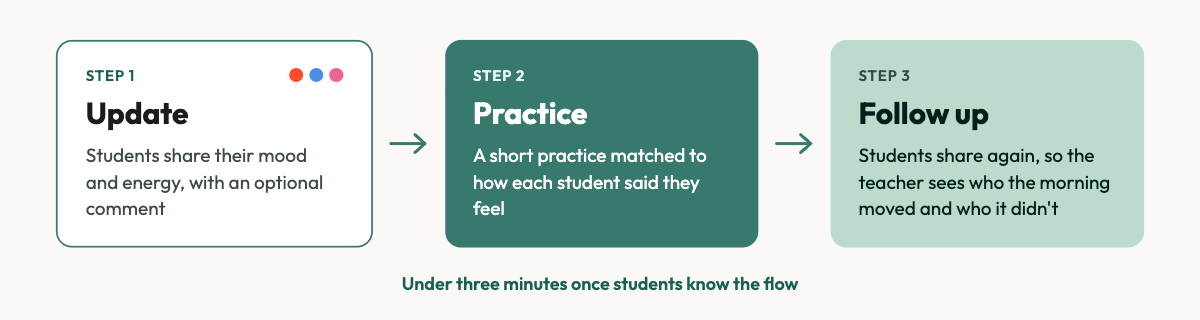
Students share their update, then spend a minute or two on a short practice matched to it. A student running high might do a breathing exercise to settle; a student running low might do something to raise their energy. Then they share a second, brief update.
That second update is what sets this approach apart. The teacher sees how each student walked in, and also how they report feeling a few minutes later. The students who steadied after the practice and the ones who didn’t are both visible, and the ones who didn’t are often the ones to check on first.
For the student, the routine is a moment that belongs to them: name how you feel, do something about it, notice whether it changed.
The cost is time. Under three minutes is still three minutes the lesson doesn’t have, and it only works if it becomes routine rather than an occasional extra.
How to decide
- If minutes are the binding constraint, an update alone gives most of the visibility for the least time.
- If students are arriving dysregulated and the first part of the lesson is lost anyway, the full routine spends a few minutes up front to get them back.
- If your counselors need to know who to see first, either approach beats reading the room alone, because elevated concerns surface before the first period instead of after a referral.
- Whatever you choose, keep reading the room. None of these approaches replace a teacher who notices.
Frequently asked questions
Isn’t this just a mood survey? No. A survey is something students take occasionally, and the results arrive later. A morning routine is short, happens at the start of class, and the teacher sees it before the lesson begins.
Do the practices have to be complicated? No. Many are standard techniques, like paced breathing. What matters is matching the practice to how the student said they feel, so a student who is wound up isn’t asked to energize and a student who is flat isn’t asked to calm down.
What happens when a student shares something serious? The teacher sees it, and elevated concerns are routed to the school counselor so the right adult can follow up.
Does it replace the teacher’s judgment? No. It adds to what the teacher can see. The teacher still decides who to talk to and when.
Where Class Catalyst fits
Class Catalyst is built around the third approach: a morning routine of update, practice and follow up. Its practices were developed with our partners at Mindful Practices and matched to each mood and energy level. Teachers see who’s ready to learn, and elevated concerns go to the school counselor.

Recent Comments