
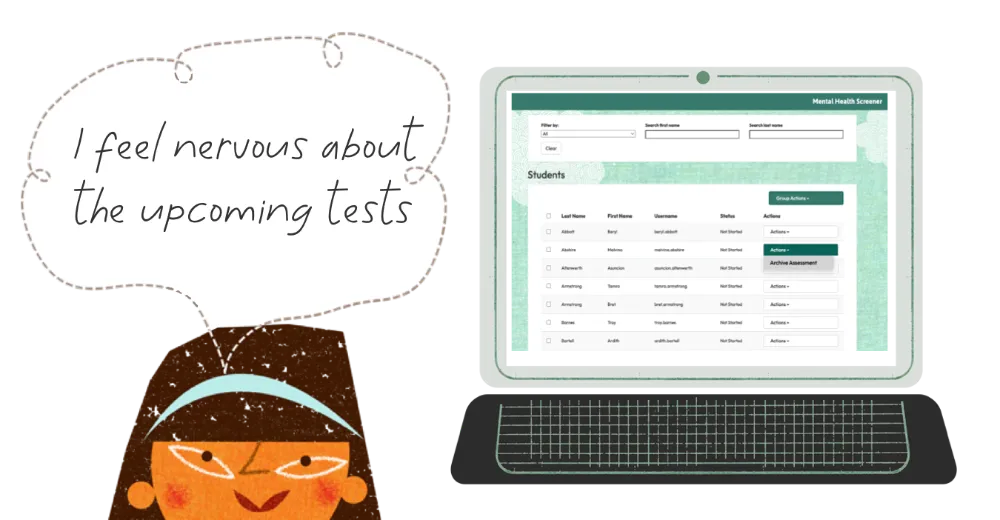
Every student deserves a way to say they’re not okay.
The Class Catalyst Mental Health Screener gives them one — privately, in their own words, with the people who are there to help already standing by.
Mission Before Features
Screening that works starts with students who trust it.

The most carefully designed screening program fails if students don’t believe their honest answers are safe. That’s not a technology problem — it’s a trust problem.
And it’s why the Class Catalyst Mental Health Screener was built from the ground up around student voice and privacy.
Students complete the screener themselves. Their responses go directly to your school’s mental health staff — and only your school’s mental health staff. No teacher sees it. No administrator sees it. No one outside your designated team sees it.
When students know that, they answer honestly. And honest answers are the only kind that help.
The Screener
Clinically validated. Practically designed.
The Class Catalyst Mental Health Screener uses the Pediatric Symptom Checklist – Youth (PSC-Y), a clinically validated screening instrument with decades of research behind it. The PSC-Y is publicly available, transparent, and designed for student self-completion — which means families can see exactly what their child will be asked before it happens.
It takes most students under five minutes, and it’s available in Spanish, with audio versions in English and Spanish. The PSC-Y is also one of four instruments reviewed in the Illinois State Board of Education’s August 2026 screening guidance for districts.
No proprietary black box. No mystery about what the questions mean or how responses are interpreted. Transparency is built into the instrument itself.
Two Ways to Screen
One screener. Two ways to deliver it. You choose what fits your school.

Standalone Screener
- What it is: A single-session screening event, delivered when and how your school needs it. Counselors initiate the screener for individual students, a classroom, a grade level, or the whole school at once.
- How it works: Students complete the PSC-Y entirely on their own — no teacher involvement, no observer in the room. Results go directly to your school’s mental health staff, who review them and determine next steps.
- Who it’s for: Schools that want a discrete, flexible screening option — whether for an annual event, a response to a specific situation, or a first step toward a more integrated practice.
- Built for students in Grades 3–12. Audio versions in English and Spanish mean younger readers can answer on their own, too.
- What your team sees: Results are visible only to your designated mental health staff. No one else in the building has access.
Integrated Screener
- What it is: The PSC-Y delivered gradually, embedded within the daily status update students already know and trust. Over the course of several status updates, students complete the full screener without it ever feeling like a formal event.
- How it works: A small number of PSC-Y questions appear after a student’s regular status update. The questions are introduced naturally, without fanfare, across 5–7 status updates. By the end of that window, the screener is complete — and because it arrived through a familiar, trusted channel, students engage with it the way they engage with the status update itself.
- Who it’s for: Schools already running Class Catalyst morning routine who want to build screening into the rhythm of the school year — with minimal overhead and maximum continuity of care.
- Built for students in Grades 3–12. Audio versions in English and Spanish mean younger readers can answer on their own, too.
- What your team sees: The same as the standalone: results go directly to mental health staff only. The integration with daily status updates does not change who can see screening data.
Privacy & Access
The right people. Only the right people.

Mental health screening data is among the most sensitive information a student can share. Treating it that way isn’t a feature — it’s a baseline.
Only your mental health staff see it. Screening results are accessible only to the mental health staff your school designates. Teachers don’t see it. Principals don’t see it. It doesn’t appear in teacher dashboards or aggregate reports. Access is role-based and restricted by design — in both the standalone and integrated versions.
Built on school data law, not around it. Screening results are handled under FERPA, the Illinois School Student Records Act, and SOPPA. Where Illinois’ Mental Health and Developmental Disabilities Confidentiality Act applies to how results are used, your district’s response pathway governs that step. Underneath it all is HIPAA-compliant infrastructure, a level above what school data law requires.
Student-completed. Always. The PSC-Y requires student self-completion — and so does responsible implementation. Students are the ones answering for themselves, in their own words, about their own experience. That directness is part of what makes the data meaningful.
Your consent model, your call. Your district manages consent — opt-in or opt-out — according to state law and your community’s preferences, and the screener works within whichever model you choose. With the integrated screener, your team controls whether screener questions appear during students’ status updates. Families can review every question before their child is screened.
What Happens Next?
Identifying need is only the beginning.
Screening that surfaces a student’s need without a clear path to support doesn’t help — it creates a different kind of harm. That’s why Class Catalyst connects screening to your school’s existing mental health infrastructure, not around it.
When a student’s responses cross a clinical threshold, your designated staff are alerted right away, and if alerts are still waiting, your administrator hears about it before the week is out. Your team also gets the tools for what comes next: a post-screening planning guide, a counselor quick-reference with urgency tiers, and a resource library organized by what the screener surfaced. Acting on results (counseling, services, referrals) is a separate consent step your district manages; we help you plan for it before screening day.
Your mental health staff receive results and determine next steps based on your school’s defined response pathway. Class Catalyst provides the signal. Your team provides the care.
The Connection to Class Catalyst
Screening that grows from trust, not from scratch.

For schools already running Class Catalyst morning routine, the integrated screener isn’t a new ask — it’s an extension of something students already do. The trust is already built. The habit is already there. The screener arrives through a channel students know, which changes how they engage with it.
For schools new to Class Catalyst, the standalone screener offers a starting point — a focused, manageable first step that doesn’t require adopting a full platform before you’re ready.
Either way, the belief is the same: screening works best when it’s built on a foundation of connection, not compliance.
Planning for Illinois’ screening requirement?
Starting in the 2027–28 school year, Illinois districts must offer students in Grades 3–12 at least one mental health screening each year. Our Illinois Screening Guide walks through what ISBE’s guidance actually asks of districts, including consent, follow-up, and referral pathways.
Ready to Get Started?
Your students are ready to be honest. Give them a safe way to be.

The Class Catalyst Mental Health Screener is clinically validated, student-completed, built on school data law, and designed around the privacy your students and families expect.